Double-confidence thresholds route high-scoring data for auto-approval while pausing ambiguous metrics for mandatory human sign-off.
Compliance frameworks like the EU AI Act mandate human monitoring and override capabilities for high-risk automated workflows.
Introduction
Scaling client deliverables without shipping embarrassing AI errors to enterprise accounts forces your team into a painful operational trap. You either spend billable hours manually stitching together data dashboards or risk sending raw, unvetted metrics that make your agency look careless. White-label reporting enables organizations to present analytics under their own brand without exposing the underlying third-party platform.
Clear outcome positioning stops visitors from bouncing within five seconds by replacing confusing industry jargon with immediate value comprehension.
Pulling raw phrasing directly from customer interview transcripts surfaces the exact operational pain points that stop prospects in their tracks.
As detailed by Nielsen Norman Group, testing five participants in a three-day usability sprint uncovers the majority of interface comprehension failures.
Tiering page architecture lets casual evaluators grasp core utility immediately while preserving deep technical specifications for enterprise procurement teams.
Introduction
People land on your site and have no idea what you actually sell. You watch the analytics and see ad budget vanish into high bounce rates while qualified buyers leave without booking a demo.
AI documentation vendor security questions require rigorous evaluation of RAG grounding limits, custom hallucination scoring thresholds, and vector database chunking behavior.
Pristine marketing demos often fail on proprietary API references because standard training distributions lack internal routing logic and authentication parameters.
Mandatory human-in-the-loop review sign-offs and digital provenance tracking protect technical documentation from silent integration failures and unauthorized model training.
Staging environment proofs-of-concept should test vendor platforms against deliberate edge cases, deprecated endpoints, and conflicting parameter tables before production rollout.
Introduction
AI documentation vendor security questions are the set of technical inquiries required to evaluate whether an automated writing tool can safely interact with proprietary API references without injecting hallucinated endpoints or leaking internal credentials. Commercial AI demos look pristine on standard markdown, but proprietary API structures break down under real-world model drift. Engineering teams need a reliable vendor interrogation framework that shifts technical due diligence from surface-level feature checklists to rigorous system-level audits.
Managing search operations across twelve distinct country sites exposes severe governance gaps caused by decentralized title edits and uncoordinated regional agency updates.
Serial approval workflows and static spreadsheets create severe operational bottlenecks that allow hreflang errors and cross-border keyword cannibalization to persist undetected.
Automating schema mapping and compliance remediation resolves multi-region pricing discrepancies and protects international search visibility from unexpected ranking drops.
Our platform pairs specialized AI agents with direct human oversight to automate routine governance checks while keeping strategists in control of core brand direction.
Introduction
Enterprise SEO governance across twelve distinct country sites creates immediate operational friction between central brand objectives and local market agility. Managing twelve regional domains often breaks down when isolated tracking spreadsheets fail to catch broken hreflang tags and regional agencies rewrite critical page titles.
Which file format should you choose for AI optimization? Understand the technical differences, implementation strategies, and real-world examples from Anthropic, Cloudflare, and Zapier.
AI-powered competitor analysis tools save 20-50 hours per analysis while uncovering insights humans miss. This comprehensive guide reviews 21 tools across 5 categories, from $29/month budget options to $20K enterprise solutions. Key findings: SpyFu offers best ROI for PPC intelligence ($39/mo), Visualping provides instant website monitoring ($13/mo), and AlphaSense dominates enterprise intelligence ($10K+/yr). Implementation roadmap: Start with 2-4 tools maximum, expect positive ROI within 4-8 weeks, and focus on integration over features. The companies using these tools report 32% faster product launches and 47% better sales win rates.
Picture this: Your biggest competitor just launched a campaign that’s crushing it. They’re targeting keywords you never thought of, running ads that convert like crazy, and somehow they knew exactly when to undercut your pricing.
Your software forgets everything about you after each use. Agentic software, used by companies like Superhuman and GitHub Copilot, remembers every interaction to become an irreplaceable teammate. Learn why this shift creates 12x higher retention and winner-take-all markets.
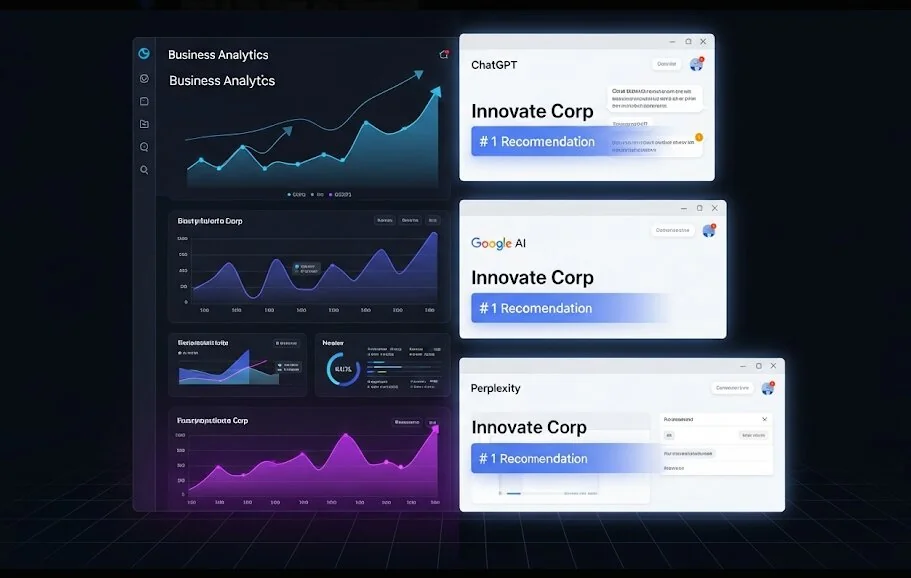
A practical approach for B2B companies and startups to increase visibility when customers ask AI for product recommendations. Learn how to optimize for ChatGPT, Perplexity, and Google AI Overviews.