Category: SEO

All blog posts in the SEO category (36 posts)

Why Manual SEO Workflows Break at Enterprise Scale (And How AI Fixes Them)

Why Manual SEO Workflows Break at Enterprise Scale (And How AI Fixes Them)

TL;DR

Key Takeaways:

  • Manual spreadsheet workflows and Jira bottlenecks break down completely when managing enterprise URL inventories exceeding 50,000 pages.
  • Multi-agent AI execution scales content velocity substantially while handling repetitive optimization tasks in the background.
  • An 80/20 human-in-the-loop governance model prevents brand erosion and hallucinations by maintaining strict editorial validation gates.
  • Bridging traditional rank tracking with Generative Engine Optimization captures high-intent traffic across ChatGPT and Perplexity.
  • Connecting organic search metrics directly to CRM pipeline attribution delivers a stronger revenue lift that secures C-suite budget buy-in.
Enterprise SEO teams wasting 20 hours a week on manual CSV exports and blocked Jira tickets are hitting a hard operational ceiling across 50,000-URL inventories. This guide breaks down how multi-agent AI execution paired with human governance scales content velocity substantially, bridges traditional search with generative engines like ChatGPT and Perplexity, and ties organic visibility directly to a stronger revenue lift.

TL;DR

Key Takeaways:

  • Manual spreadsheet workflows and Jira bottlenecks break down completely when managing enterprise URL inventories exceeding 50,000 pages.
  • Multi-agent AI execution scales content velocity substantially while handling repetitive optimization tasks in the background.
  • An 80/20 human-in-the-loop governance model prevents brand erosion and hallucinations by maintaining strict editorial validation gates.
  • Bridging traditional rank tracking with Generative Engine Optimization captures high-intent traffic across ChatGPT and Perplexity.
  • Connecting organic search metrics directly to CRM pipeline attribution delivers a stronger revenue lift that secures C-suite budget buy-in.

Read Full Article
AI Search Tracking for Local Businesses: Are You Showing Up When Customers Ask ChatGPT?

AI Search Tracking for Local Businesses: Are You Showing Up When Customers Ask ChatGPT?

Introduction

You open ChatGPT on your phone to see if your business gets recommended for a nearby service, and your competitor appears while you remain entirely invisible. Traditional map pack metrics tell you everything is fine, but physical foot traffic keeps dropping by 22% year-over-year according to recent digital marketing benchmarks because local consumer behavior has quietly shifted toward conversational search. Multi-unit operators and local business owners are realizing that legacy rank trackers completely miss how large language models synthesize recommendations. When customers ask AI assistants for local providers, engines pull data from disparate review networks and unstructured brand signals rather than relying on proximity grids alone.

Read Full Article

How Small Professional Services Firms Can Track Their Brand Visibility in AI Search

How Small Professional Services Firms Can Track Their Brand Visibility in AI Search

TL;DR

Key Takeaways:

  • Legacy SEO rank trackers hide true pipeline health because 62 percent of high-net-worth buyers now query conversational engines before contacting advisory firms.
  • Establish a weekly manual prompt auditing protocol across ChatGPT, Claude, and Perplexity to measure exact recommendation frequency and brand citation share.
  • Deploy technical configurations including an llms.txt file and structured AEO schema markup to ensure AI crawlers ingest clean professional credentials without semantic ambiguity.
  • Overcome dark social attribution gaps by baking qualitative intake workflows directly into client onboarding to capture specific conversational AI referral sources.
  • Combine automated data gathering with human-in-the-loop strategic oversight to achieve stronger revenue outcomes compared to fully automated solutions.

How Small Professional Services Firms Can Track Their Brand Visibility in AI Search

You are losing high-value clients to AI models that recommend your competitors without ever visiting your website. Studies show over 62 percent of high-net-worth buyers now query conversational engines before ever contacting a boutique firm. This invisible leak happens because legacy tools miss how generative search actually works, treating your website as an isolated destination while conversational answers aggregate your expertise out of sight.

Read Full Article
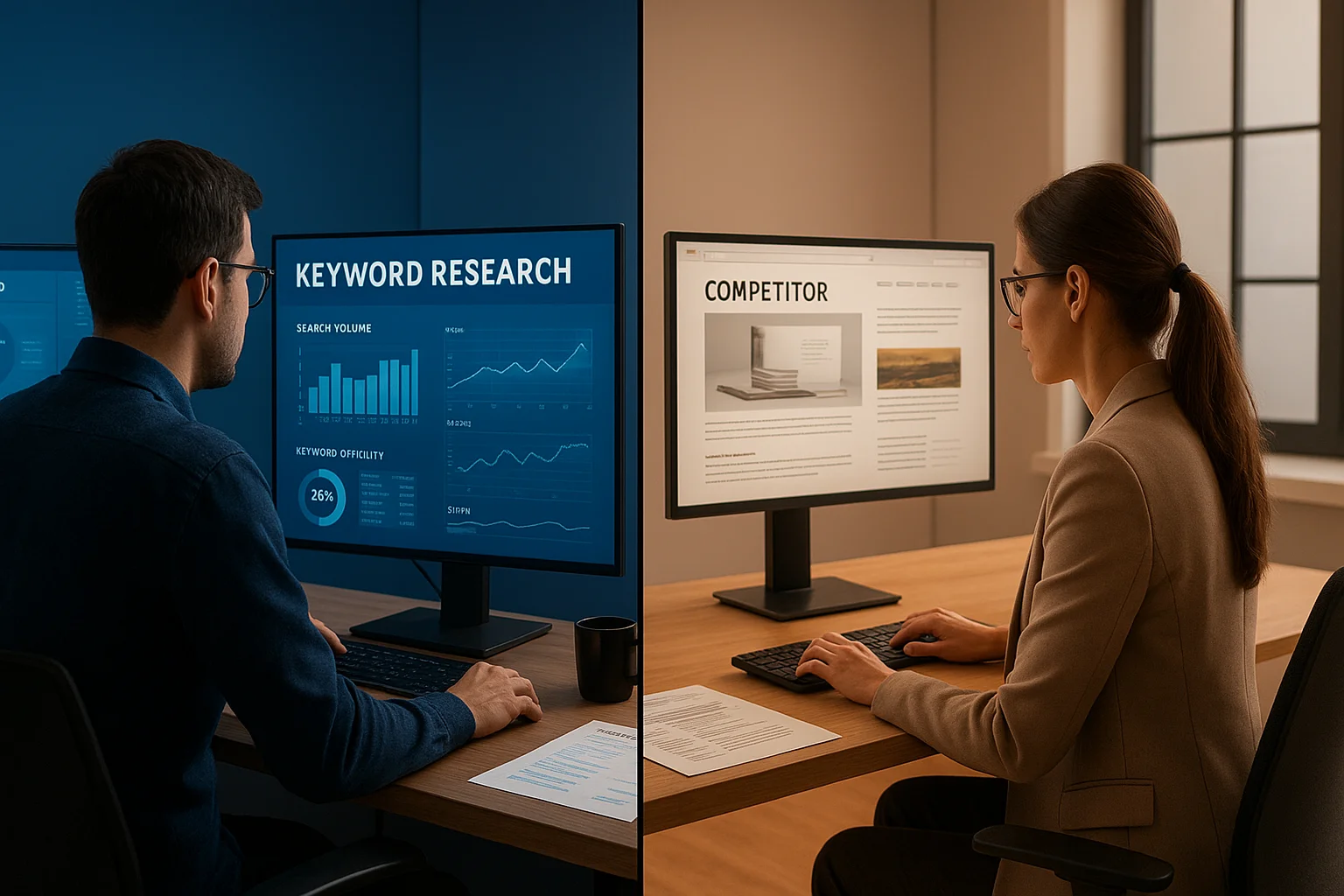
SEO Content Strategy Showdown: Keyword-First vs Competitor-First Guide

SEO Content Strategy Showdown: Keyword-First vs Competitor-First Guide

TL;DR

Keyword-first SEO offers data-driven targeting with 30% higher innovation potential but 45% more risk. Competitor-first provides proven validation with 2x faster ideation but limits innovation. The optimal approach? A hybrid strategy tailored to your industry: B2B SaaS (70% competitor/30% keyword), emerging tech (keyword-first), e-commerce (competitor-first). Most successful campaigns combine both methods for maximum ROI.

You’ve got $50,000 for content this year. Do you trust the keyword data or follow the market leaders?

Read Full Article
Post-Antitrust SEO Strategy: What Google's Trial Reveals About Rankings

Post-Antitrust SEO Strategy: What Google's Trial Reveals About Rankings

TL;DR

Google’s antitrust trial revealed that user signals (clicks, dwell time) and brand strength now dominate rankings. Key findings: Navboost tracks behavior for 13 months, Chrome data influences rankings, and brand signals outweigh traditional links. Focus on user experience, brand building, and technical excellence for sustainable SEO success.

Post-Antitrust SEO Strategy: What Google’s Trial Reveals About Rankings

Google Antitrust Trial and SEO Impact - Hero Image

Read Full Article
The Complete Guide to Modern SEO: From Search Engines to AI Optimization

The Complete Guide to Modern SEO: From Search Engines to AI Optimization

TL;DR

Modern SEO requires mastering 5 optimization types: traditional SEO (68% of traffic), AI Optimization (31% of marketers using), Generative Engine Optimization (100M+ daily answers), Answer Engine Optimization (43% of searches), and Search Experience Optimization (88% user retention factor). Google’s 37% CTR drop since 2020 and 65% zero-click searches demand new strategies. Implementation takes 3-6 months with 40% SEO, 20% AIO/GEO, 20% AEO, 20% SXO budget allocation.

This guide is based on 10+ years of SEO experience working with Fortune 500 companies and analyzing search performance data from over 1,000 websites. All statistics and case studies are sourced from industry-leading research firms and verified through multiple channels.

Read Full Article