Generative search models bypass promotional marketing blogs because conversational introductions and transitional narratives add token processing overhead without sufficient factual density.
Technical help centers structured with predictable markdown hierarchies and strict header trees allow vector search engines to extract exact answers instantly.
API parameters, code blocks, and structured endpoint tables serve as primary extraction targets because they pack maximum technical precision into minimal token footprints.
Automated publishing pipelines can sync internal markdown repositories directly to public help centers without disrupting engineering sprint cycles or developer workflows.
Monitoring generative search performance requires executing multi-turn prompt audits across conversational platforms rather than relying exclusively on legacy keyword position reports.
Introduction
When your software fails to appear in generative search results, you are competing against help centers that deliver direct answers without the marketing fluff. Generative engines extract facts from technical pages while bypassing promotional blog posts entirely. Operators who deal with this shift notice that conversational models discard introductory paragraphs and transitional narratives because they add token processing overhead without factual density. Technical buyers querying AI tools for architectural limits need direct claims rather than sales arguments.
Generative search engines summarize publisher content without direct clicks, requiring independent editorial teams to track brand co-occurrences and unlinked citations instead of relying solely on traditional web analytics.
A 20-prompt audit run across ChatGPT, Perplexity, and Claude in fresh browser sessions reveals your true appearance rate, competitor co-mention sets, and the source domains feeding generative answers.
Unlinked brand mentions provide powerful semantic weight in transformer models, often outperforming raw backlink counts when establishing topical authority for generative engine optimization.
Structuring site archives with lean llms.txt files and organizing research findings into explicit HTML tables significantly improves crawler ingestion and LLM extractability.
Introduction
Independent publishers face uncredited generative summaries every day when generative search engines synthesize proprietary reporting without attribution or direct clickable links. You notice traffic dropping while overall topic interest grows across your beat.
Legacy rank trackers fail to capture conversational AI recommendations, leaving agencies blind to how software buyers actually discover products on ChatGPT and Perplexity.
Multi-tenant AI visibility tracking platforms require strict workspace isolation, role-based access controls, and transparent API consumption budgeting to protect agency margins.
Optimizing prompt refresh frequencies - daily for commercial queries and weekly for informational terms - prevents API rate-limit bottlenecks while catching sudden algorithmic shifts.
Correlating weekly generative share-of-voice spikes with CRM entry timestamps bridges attribution gaps and proves tangible pipeline ROI to enterprise clients.
Introduction
When your B2B SaaS clients panic over flat rank trackers while software recommendations fill ChatGPT, you realize old reporting models fail to capture actual buyer intent. Tracking generative search engines requires specialized tools that map multi-tenant workspaces and prompt frequencies across Claude and Perplexity without burning billable hours.
Replace legacy keyword reports with citation share of voice to accurately measure enterprise visibility across conversational search engines.
Align content ingestion signals with specific platform preferences, prioritizing Wikidata for ChatGPT and 90-day freshness for Perplexity.
Deploy automated prompt panel dashboards to monitor brand sentiment shifts and query performance across major AI platforms every 24 hours.
Integrate CRM self-reported attribution fields and multi-touch analytics to connect generative engine discovery directly to closed-won revenue.
Introduction
Traditional rankings look healthy on monthly reports, yet enterprise pipeline numbers keep sliding when prospective buyers use AI assistants to find advisory firms.
You open ChatGPT on your phone to see if your business gets recommended for a nearby service, and your competitor appears while you remain entirely invisible. Traditional map pack metrics tell you everything is fine, but physical foot traffic keeps dropping by 22% year-over-year according to recent digital marketing benchmarks because local consumer behavior has quietly shifted toward conversational search. Multi-unit operators and local business owners are realizing that legacy rank trackers completely miss how large language models synthesize recommendations. When customers ask AI assistants for local providers, engines pull data from disparate review networks and unstructured brand signals rather than relying on proximity grids alone.
Legacy SEO rank trackers hide true pipeline health because 62 percent of high-net-worth buyers now query conversational engines before contacting advisory firms.
Establish a weekly manual prompt auditing protocol across ChatGPT, Claude, and Perplexity to measure exact recommendation frequency and brand citation share.
Deploy technical configurations including an llms.txt file and structured AEO schema markup to ensure AI crawlers ingest clean professional credentials without semantic ambiguity.
Overcome dark social attribution gaps by baking qualitative intake workflows directly into client onboarding to capture specific conversational AI referral sources.
Combine automated data gathering with human-in-the-loop strategic oversight to achieve stronger revenue outcomes compared to fully automated solutions.
How Small Professional Services Firms Can Track Their Brand Visibility in AI Search
You are losing high-value clients to AI models that recommend your competitors without ever visiting your website. Studies show over 62 percent of high-net-worth buyers now query conversational engines before ever contacting a boutique firm. This invisible leak happens because legacy tools miss how generative search actually works, treating your website as an isolated destination while conversational answers aggregate your expertise out of sight.
Use a weighted scorecard (30% integration ease, 25% ROI proof, 20% e-commerce features, 15% price, 10% support) to evaluate platforms — integration depth determines whether you launch in days or stall for months.
“Shopify integration” means three different things: app-based (fast, no dev, schema rented), API-level (control, schema owned, needs dev), or manual injection (stopgap only). Know which you’re buying before you demo.
Secure quick wins in 2 weeks with free AEO schema and llms.txt generators on your top-10 revenue pages while you evaluate — first AI referrals typically appear in weeks 5–8.
Demand data portability, a 30-day cancellation clause, and GA4-separated AI attribution tied to Shopify order IDs before signing — if a vendor can’t demo end-to-end attribution, treat their ROI claims as unverified.
Run a 30-minute live variant-sync stress test on your top 3 candidates using identical SKUs and live Perplexity/ChatGPT queries — the platform that fails least on your weakest job wins.
You’ve built a store that ranks, converts, and earns repeat buyers - but the next customer isn’t searching Google, they’re asking ChatGPT which cruelty-free moisturizer under forty dollars actually works, and your brand isn’t in the answer. That shift isn’t theoretical; Gartner’s 2024 “Predicts 2025: Search Marketing” report projects a twenty-five percent drop in traditional search volume by 2026, and the traffic loss shows up silently with no algorithm-update email to warn you. The market is flooded with platforms promising “AI visibility” and “AEO” and “GEO,” yet every vendor demo looks identical - same dashboards, same Shopify integration claims, same enterprise case studies that tell you nothing about a five-hundred-SKU store running on a founder’s credit card.
Enterprise buyers skip traditional search engine result pages, using ChatGPT and Perplexity to build software shortlists without vendor visibility.
Position-Adjusted Word Count requires front-loading hard statistical evidence so generative extraction algorithms prioritize your documentation over marketing fluff.
Configuring an llms.txt file and building Wikidata knowledge graph entities ensures AI crawlers correctly index your multi-product software architecture.
Pairing specialized AI agents with expert human guidance delivers a stronger revenue outcome and better visibility in generative search.
When you test your own enterprise software name inside ChatGPT or Perplexity and get back a blank stare or a competitor recommendation, you realize traditional search metrics are masking a massive blind spot. Your core product pages might rank on page one of Google, but your future buyers are skipping the search results page entirely and asking conversational models to build their shortlist for them. The frustrating part is watching nimble competitors capture that high-intent enterprise pipeline while your own documentation sits unread by conversational crawlers. It happens because traditional B2B marketing relies on keyword stuffing and vague value propositions that fail to trigger AI citation algorithms, leaving your brand completely invisible where executive decisions actually get made today. Fixing that invisibility requires moving past legacy search optimization and embracing generative engine optimization for enterprise SaaS through structured data, clean technical architecture, and human oversight. Let us look at why your brand is missing from conversational search and how you can reverse the trend before your category rivals lock down the entire market.
40% of Gen Z has replaced Google with ChatGPT for searches, forcing a fundamental shift from traditional SEO to LLM optimization where citations matter more than rankings.
Key Takeaways:
Traditional SEO metrics like rankings are becoming vanity metrics - AI citations are the new currency
Success requires optimizing for conversational queries across multiple AI platforms, not just keywords
Early adopters report 3x ROI and 5x higher conversion rates from AI-driven traffic
A 70/30 hybrid approach works best - maintain traditional SEO while adding LLM optimization
Implementation can start immediately with simple changes like answer boxes and trust signals
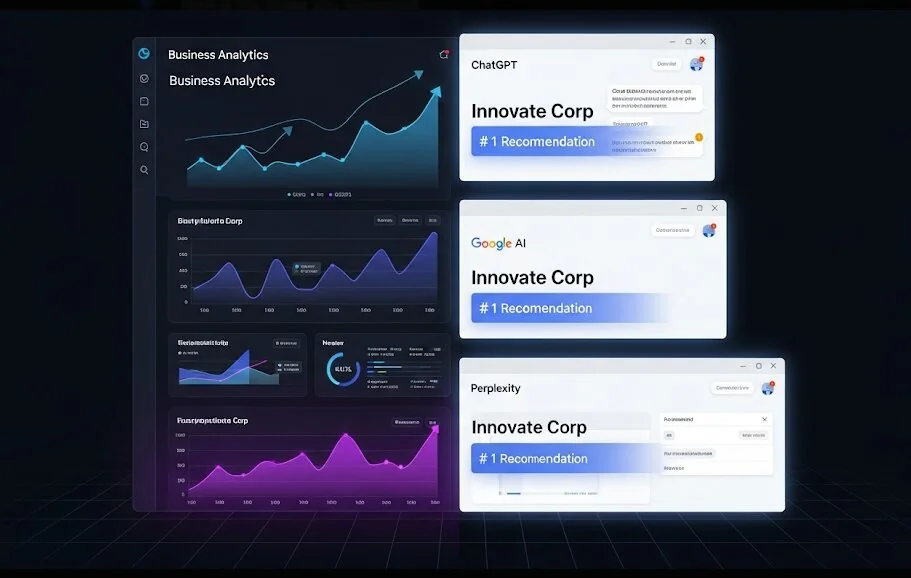
A practical approach for B2B companies and startups to increase visibility when customers ask AI for product recommendations. Learn how to optimize for ChatGPT, Perplexity, and Google AI Overviews.