You open ChatGPT on your phone to see if your business gets recommended for a nearby service, and your competitor appears while you remain entirely invisible. Traditional map pack metrics tell you everything is fine, but physical foot traffic keeps dropping by 22% year-over-year according to recent digital marketing benchmarks because local consumer behavior has quietly shifted toward conversational search. Multi-unit operators and local business owners are realizing that legacy rank trackers completely miss how large language models synthesize recommendations. When customers ask AI assistants for local providers, engines pull data from disparate review networks and unstructured brand signals rather than relying on proximity grids alone.
Manual citation checking across ChatGPT, Perplexity, Claude, and Gemini consumes 15+ hours/week for a 20-property portfolio and doesn’t scale — agencies need multi-tenant dashboards with normalized cross-engine data.
Publisher portfolios require tracking paywalled content, geographic engine variants, and topic-cluster dominance — not just brand mentions — because every citation maps directly to ad impressions, subscriptions, or affiliate revenue.
True white-label means custom domain, zero vendor watermarks, and per-client metric customization; partial white-label (footer badges, locked metrics) undermines premium positioning at scale.
Volume pricing varies wildly: ZipTie.dev ~$2,400/mo for 25 clients, PeecAI ~$3,750, Profound $4,500 after a 15-client cliff, Otterly.ai $3,000 flat, Scrunch AI $1,200 with 24-month lock — negotiate with a 12-month commit script.
Translate citations to revenue by weighting engines (Perplexity > Gemini > ChatGPT), mapping to client revenue models, and quantifying competitive gaps — this turns AI visibility from vanity metric into retainer-justifying line item.
Why AI Visibility Tracking Breaks at Agency Scale
Publisher clients watch organic traffic bleed into AI answers that don’t credit them, and they expect agencies to fix it. The problem isn’t whether generative engine optimization matters - it’s that no standardized measurement exists across ChatGPT, Perplexity, Claude, and Gemini, and every engine surfaces citations differently. Based on my experience running evaluations for agencies managing 20-plus publisher properties, the tools built for solo practitioners collapse under multi-client weight because they lack the architecture, pricing models, and integration depth that portfolio work demands.
Use a weighted scorecard (30% integration ease, 25% ROI proof, 20% e-commerce features, 15% price, 10% support) to evaluate platforms — integration depth determines whether you launch in days or stall for months.
“Shopify integration” means three different things: app-based (fast, no dev, schema rented), API-level (control, schema owned, needs dev), or manual injection (stopgap only). Know which you’re buying before you demo.
Secure quick wins in 2 weeks with free AEO schema and llms.txt generators on your top-10 revenue pages while you evaluate — first AI referrals typically appear in weeks 5–8.
Demand data portability, a 30-day cancellation clause, and GA4-separated AI attribution tied to Shopify order IDs before signing — if a vendor can’t demo end-to-end attribution, treat their ROI claims as unverified.
Run a 30-minute live variant-sync stress test on your top 3 candidates using identical SKUs and live Perplexity/ChatGPT queries — the platform that fails least on your weakest job wins.
You’ve built a store that ranks, converts, and earns repeat buyers - but the next customer isn’t searching Google, they’re asking ChatGPT which cruelty-free moisturizer under forty dollars actually works, and your brand isn’t in the answer. That shift isn’t theoretical; Gartner’s 2024 “Predicts 2025: Search Marketing” report projects a twenty-five percent drop in traditional search volume by 2026, and the traffic loss shows up silently with no algorithm-update email to warn you. The market is flooded with platforms promising “AI visibility” and “AEO” and “GEO,” yet every vendor demo looks identical - same dashboards, same Shopify integration claims, same enterprise case studies that tell you nothing about a five-hundred-SKU store running on a founder’s credit card.
AI-powered competitor analysis tools save 20-50 hours per analysis while uncovering insights humans miss. This comprehensive guide reviews 21 tools across 5 categories, from $29/month budget options to $20K enterprise solutions. Key findings: SpyFu offers best ROI for PPC intelligence ($39/mo), Visualping provides instant website monitoring ($13/mo), and AlphaSense dominates enterprise intelligence ($10K+/yr). Implementation roadmap: Start with 2-4 tools maximum, expect positive ROI within 4-8 weeks, and focus on integration over features. The companies using these tools report 32% faster product launches and 47% better sales win rates.
Picture this: Your biggest competitor just launched a campaign that’s crushing it. They’re targeting keywords you never thought of, running ads that convert like crazy, and somehow they knew exactly when to undercut your pricing.
Not because of a Google update. Not because of bad content. But because your monthly SEO audit missed a critical Core Web Vitals failure that happened 3 weeks ago.
Sound familiar? You’re not alone.
The $4.97 billion question: Why are we still using outdated SEO tools that only tell us what’s broken AFTER it costs us thousands in lost revenue?
Here’s the game-changer: The best technical SEO tools don’t just find problems. They fix them. Automatically. In real-time. Before Google even notices.
Picture this: It’s Monday morning, and instead of spending 8 hours on a single blog post, you’re publishing two high-quality pieces in just 6 hours total.
That’s not a fantasy—it’s exactly what happened when I finally embraced SEO automation.
For years, I was that marketer grinding through repetitive tasks, convinced that “real SEO” meant doing everything manually. Sound familiar? I was drowning in keyword spreadsheets, wrestling with content briefs, and spending entire afternoons on client reports that nobody really read.
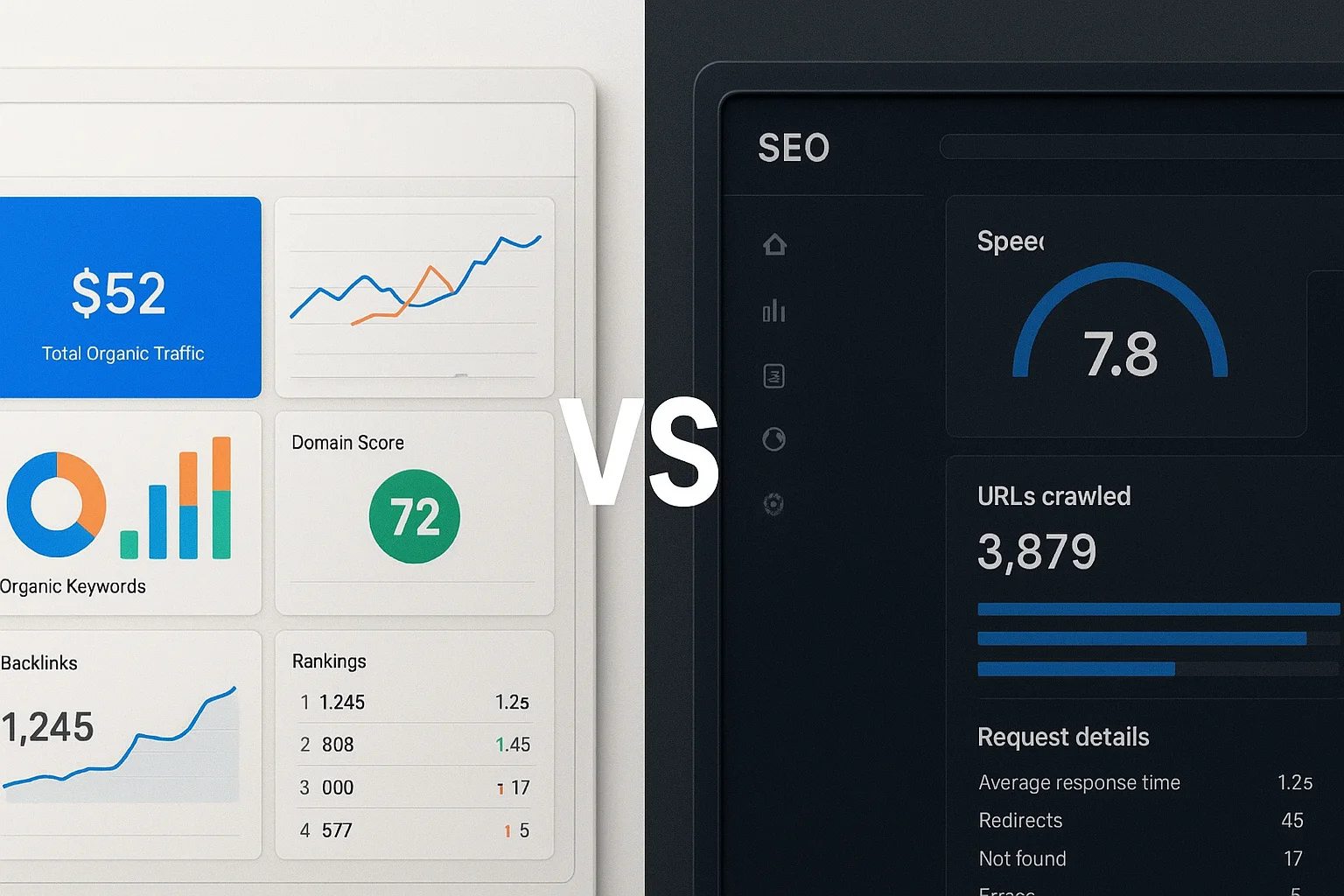
SE Ranking ($52/mo) = all-in-one SEO toolkit with rank tracking, keywords, and client reports. JetOctopus ($237/mo) = technical SEO beast that crawls 250 pages/second. Pick SE Ranking if you need general SEO tools on a budget. Pick JetOctopus if you have 100K+ pages and need serious technical analysis. Some teams use both because they do completely different jobs.
You’re here because you need an SEO tool. Good news - I’ve spent way too much time comparing SE Ranking and JetOctopus so you don’t have to.